

 Index
IndexThe Veneto: a changing region
Data on the current economic system, looked at from a broader perspective, reveal that recently the Veneto has been undergoing a slow but steady metamorphosis. Certain areas of production have become obsolete and economic components are being re-organized. We are often presented with an image of the Veneto in decline: after its extraordinary development it is beginning to show signs of weakness, the positive growth trend has been reversed and it is now facing a compromising economic situation. Yet a more careful reading both of the most critical moments and also periods of increased growth, allows us to see a changing region whose economic development has suffered setbacks, but which is beginning to adapt to structural modifications such as major demographic and territorial changes, and different international and national contexts. We are often told that the basic problem is synchronization with the outside world, which calls for fast adaptation to the new environment; it is well known that the Veneto represents the fastest-growing area on a national level, and European centrality. It is working hard to establish itself on world agendas.
 Restructuring of sectors
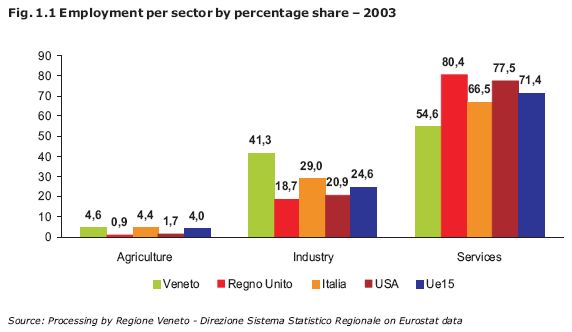
The changing of boundaries and transformation of sectors is evident and, unfortunately, is being experienced first-hand by many, but seen from a more comprehensive point of view it is one of those setbacks mentioned above. Indeed a general overview of the Veneto reveals not a crisis but a re-composition with a shift in favour of services: from 2000 to 2004 the share of value added in this sector grew by 1.3 percentage points to the detriment of industry’s share, reaching 62.4%, which is still below the national figure (69%). This process shows how even the Veneto, once a predominantly industrial region, is following the trend of major economies, which have over 70% of their employment share in services.
In Great Britain in particular, 80.4% of employment was in the service sector in 2003 compared to 18.7% in industry. In the Veneto the industry’s share, 41.3%, though, is higher than in other economies it has tended to remain stable, with clearly visible effects.
At the same time value added in the tertiary sector at the end of 2004 reached a significant level: 72.3% in United Kingdom, 69% in Germany, 72.8 in France while industry’s value share was between 20 and 30%.
This trend is also confirmed by data on the Veneto’s economy in 2004 with its GDP growing at 1.4% and in subsequent years the increase of value added in services, +1.7% in 2005, and +2% in 2006.
Tertiarisation has somehow constrained productivity growth, mainly including highly labour-intensive activities. However recent trends, regarding above all the potential of the Veneto in research and innovation, lead us to believe that we have already taken steps in the direction indicated by many.
In Great Britain in particular, 80.4% of employment was in the service sector in 2003 compared to 18.7% in industry. In the Veneto the industry’s share, 41.3%, though, is higher than in other economies it has tended to remain stable, with clearly visible effects.
At the same time value added in the tertiary sector at the end of 2004 reached a significant level: 72.3% in United Kingdom, 69% in Germany, 72.8 in France while industry’s value share was between 20 and 30%.
This trend is also confirmed by data on the Veneto’s economy in 2004 with its GDP growing at 1.4% and in subsequent years the increase of value added in services, +1.7% in 2005, and +2% in 2006.
Tertiarisation has somehow constrained productivity growth, mainly including highly labour-intensive activities. However recent trends, regarding above all the potential of the Veneto in research and innovation, lead us to believe that we have already taken steps in the direction indicated by many.
 Innovative potential
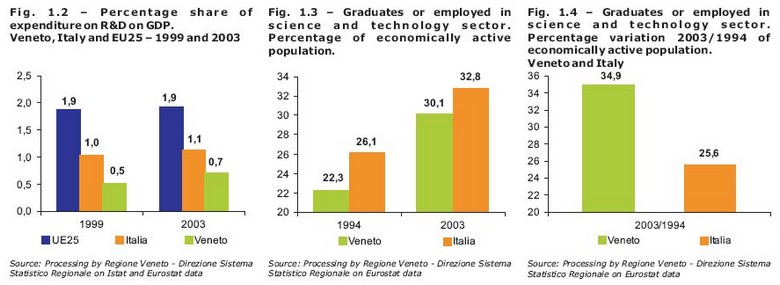
Though Research and Development expenditure as a share of GDP in Veneto (0,7%), as in Italy (1.1%), is still meagre if we look at the European objective of 3% to be attained by 2010, this type of investment has evolved considerably in recent years, increasing by about 40% from 1999 to 2003.
Individuals with a graduate or post-graduate degree, are considered of potential in this sector. Although Italy is one of the countries with the lowest proportion of graduates – 10.7% of the population between 25 and 64 years had a degree in 2003, 9.1% in Veneto – the gap is closing and the education level in Italy and in the Veneto is continuously improving. In the last ten years the number of graduates in the Veneto has more than doubled.
This potential is therefore growing, as is also witnessed by the major increase (25.6%) in the last ten years of graduates or people working in the science and technology sectors (c.33% in Italy), though it is still far from European levels where in most countries it is above 50%. This share grew by nearly 35% in the Veneto, much more so than the national share, which is only slightly above 30%.
Individuals with a graduate or post-graduate degree, are considered of potential in this sector. Although Italy is one of the countries with the lowest proportion of graduates – 10.7% of the population between 25 and 64 years had a degree in 2003, 9.1% in Veneto – the gap is closing and the education level in Italy and in the Veneto is continuously improving. In the last ten years the number of graduates in the Veneto has more than doubled.
This potential is therefore growing, as is also witnessed by the major increase (25.6%) in the last ten years of graduates or people working in the science and technology sectors (c.33% in Italy), though it is still far from European levels where in most countries it is above 50%. This share grew by nearly 35% in the Veneto, much more so than the national share, which is only slightly above 30%.
 Employment
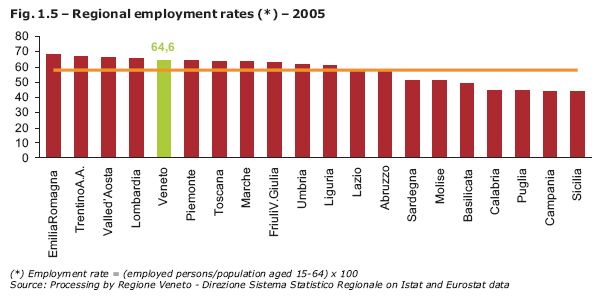
The state of employment is generally good. Of the 158,000 more workers present in Italy in 2005, 21,000 were employed in the Veneto (over 13%). Compared to the previous year, therefore, employment in Italy, +0.7%, as in the Veneto, +1%, continued to grow. The employment rate in the Veneto reached 64.6% compared with 64.3% the previous year, thus affirming itself as significantly above the national average (57.%), partly due to the regularisation of foreign nationals: foreign workers currently make up about 5.4% of the workforce, and just under two-thirds are concentrated in the north. The growth in employment is also significantly affected by a longer working life as well as an actual increase in jobs.
Employment in the Veneto is approaching the objectives set by the European Union in Lisbon in 2000: the employment rate for males in 2005 was 75.8%, higher than the national rate, 69.7%. In the same year, however, the employment rate for women of working age in the Veneto was 53%, significantly above the national average, 45.3%, but still below European norms.
Employment cannot increase if nothing is done to promote the participation of those in the later stages of their working life. One of the objectives set by the European Union in Stockholm in 2001 indeed regards the increased employment of people aged 55-64, with a 50% employment rate to be met by 2010.
The data for the Veneto come to only slightly over half of the European target, 27.4% in 2005, and is also below the national average, 31.4%; therefore reaching the objective in the next four years will be a difficult task.
However the young generation is fast approaching the European norm: 82.6% of 25 to 34 year-olds work, compared with 69.3% on a national level, and it is interesting to note how high the employment rate is for women aged 25-34 (74.7%), compared with the Italian level (58.2%). This is favoured by an increasing propensity for flexibility, as emerges from the increase in part-time employment.
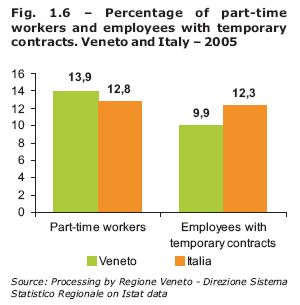
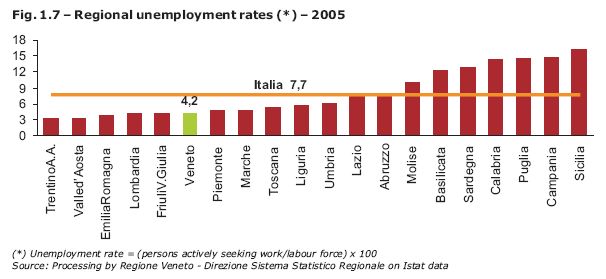
It is worth noting here that this type of flexibility in the Veneto is of a more “stable” nature, which is not a contradiction of terms. Part-time employment, 13.9% of those employed in 2005, was up from 12.9% in 2004, and it is above last year’s national level of 12.8%, while the percentage of fixed-term employees in the Veneto is one of the lowest of all the regions, 9.9%, also below the national average, 12.3%.The unemployment rate in the Veneto, once again in 2005, was equivalent to 4.2% of the workforce and did not change with respect to the previous year. In these years it has remained quite low, particularly in comparison with the national level which, despite being in constant decline, was still 7.7% of the workforce in 2005.
A moderate optimism can be noted in employment predictions regarding entrepreneurs. For 2005 an increase of 0.6% was predicted for the Veneto compared with 0.9% on a national level. The good performance of so-called micro-enterprises could indicate that their small size is better suited to the market needs of flexibility and specialisation since a 2.1% increase in employment is predicted for micro-enterprises.
The data for the Veneto come to only slightly over half of the European target, 27.4% in 2005, and is also below the national average, 31.4%; therefore reaching the objective in the next four years will be a difficult task.
However the young generation is fast approaching the European norm: 82.6% of 25 to 34 year-olds work, compared with 69.3% on a national level, and it is interesting to note how high the employment rate is for women aged 25-34 (74.7%), compared with the Italian level (58.2%). This is favoured by an increasing propensity for flexibility, as emerges from the increase in part-time employment.
It is worth noting here that this type of flexibility in the Veneto is of a more “stable” nature, which is not a contradiction of terms. Part-time employment, 13.9% of those employed in 2005, was up from 12.9% in 2004, and it is above last year’s national level of 12.8%, while the percentage of fixed-term employees in the Veneto is one of the lowest of all the regions, 9.9%, also below the national average, 12.3%.The unemployment rate in the Veneto, once again in 2005, was equivalent to 4.2% of the workforce and did not change with respect to the previous year. In these years it has remained quite low, particularly in comparison with the national level which, despite being in constant decline, was still 7.7% of the workforce in 2005.
A moderate optimism can be noted in employment predictions regarding entrepreneurs. For 2005 an increase of 0.6% was predicted for the Veneto compared with 0.9% on a national level. The good performance of so-called micro-enterprises could indicate that their small size is better suited to the market needs of flexibility and specialisation since a 2.1% increase in employment is predicted for micro-enterprises.
The highly positive employment situation favoured migration flows and led to a recomposition of the population, influencing its structure and growth rate.
But the well-rooted habits and traditions of the Veneto generate models of behaviour which are incorporated by the new social actors so new lifestyles, such as a higher propensity to consume and other trends linked to social evolution in a modern sense, are emerging.
But the well-rooted habits and traditions of the Veneto generate models of behaviour which are incorporated by the new social actors so new lifestyles, such as a higher propensity to consume and other trends linked to social evolution in a modern sense, are emerging.
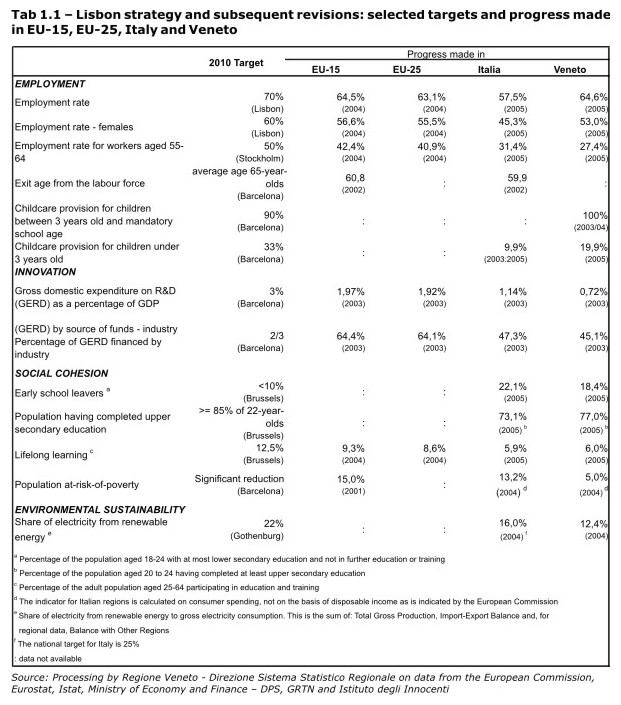
We now annually monitor the objectives cited in the various chapters of the report, set by the European Union in 2000 in Lisbon and annually verified and updated by the Commission itself. In this report we present a summary table indicating the extent to which the Veneto, Italy and Europe are reaching these objectives.